
Close Menu
Awesome Inventions
    Facebook X (Twitter) Instagram Pinterest
    Facebook X (Twitter) Instagram Pinterest
    Awesome Inventions
    Friday, March 20
    • Arts & Creative
    • Architecture & Design
    • DIY & Gardening
    • Products & Technology
    • Latest Posts
    • More Topics
      • Animals
      • Food & Drink
      • Funny
      • Health & Beauty
      • Parenting
      • People
      • Travel
      • Video
    Awesome Inventions
    Home » Products & Technology » University Student Invents Solar Panels Made From Food Waste That Produce Energy Even Through Cloudy Weather
    Products & Technology

    University Student Invents Solar Panels Made From Food Waste That Produce Energy Even Through Cloudy Weather

    Solar Panels
    Share
    Facebook Twitter Pinterest Tumblr Reddit LinkedIn

    When Carvey Ehren Maigue’s transition glasses darkened as rain clouds blanketed the sky, he realized something that the creator and manufacturers of solar panels have been missing for decades. Apparently, ultraviolet light still comes through the blanket of heavy rainclouds. He thought that it was such a big waste, since conventional panels could not absorb this energy. This realization prompted the 27-year-old electrical engineering student from MAPUA University in the Philippines to work on a new type of panel. His awesome invention, the AuREUS, went on to win the very first James Dyson Sustainability Award!

    The James Dyson Award’s primary mission is to encourage the youth to come up with designs that will solve problems around them that they think needs urgent action. The international design competition runs in 27 countries and is open to university-level students studying product design, industrial design and engineering. They have honoured numerous innovations over the years. However, 2020 is a little different as it marks the inaugural year of their Sustainability Award. And the fact that Maigue’s AuREUS Systems Technology is the very first recipient of this award couldn’t be more fitting.

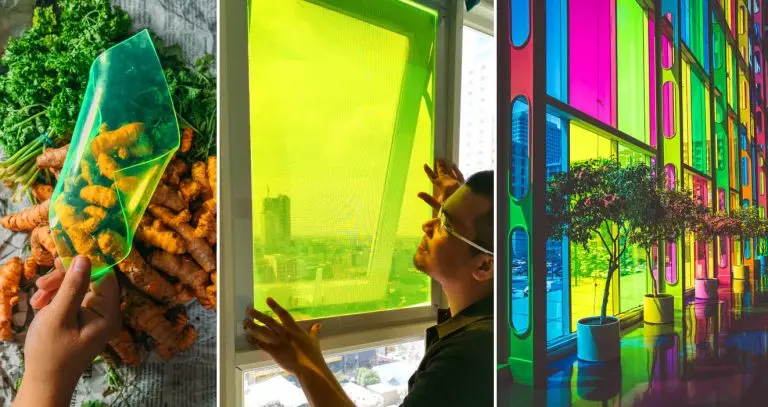
    JDA Sustainability Award 2020 Winner Carvey Ehren Maigue holds a piece of AuREUS
    The James Dyson Award


    This 27-year-old Filipino electrical engineering student made solar panels from food waste

    In an interview with Dyson, Maigue shared that this wasn’t his first time joining The James Dyson Award. He submitted a design in 2018. Sadly, he didn’t make the cut. But Maigue didn’t let this stop him. Instead, he pushed through and worked hard to come up with a better design. And he sure did! But how exactly are Maigue’s panels sustainable?

    For starters, Maigue uses food waste to make his panels. While, the conventional panels are made of silicon. But the process of manufacturing these solar energy-absorbing sheets isn’t very sustainable at all. Over the years, there have been reports that the manufacturing process of these panels contribute a great deal to chemical pollution and also emit plenty of greenhouse gas. So I think we can all agree that the introduction of Maigue’s AuREUS Systems Technology is a welcome change in this cycle! In a statement, Maigue said:

    “It champions the issues of UV sequestration, better access to solar energy for climate change mitigation and supporting the local agricultural industry hit by calamities by upcycling crops that would otherwise be considered waste thus mitigating farmer loss.”


    Maigue's AuREUS solar panels are made from food waste
    The James Dyson Award


    AuREUS are made from food waste
    The James Dyson Award


    The panels can absorb energy even when the sun isn’t shining

    Since the student discovered that there was still a strain of ultraviolet light coming through despite having clouds blanketing the sky, Maigue made sure to address this with his work. This is what sets his AuREUS panels apart from the conventional ones that we’ve seen through the years. Because in comparison with other solar panels, Maigue’s design is able to absorb ultraviolet light even when the sun is hidden behind clouds. With this issue fixed, even those living in areas that don’t enjoy much sunshine can finally install solar panels to their homes and offices!
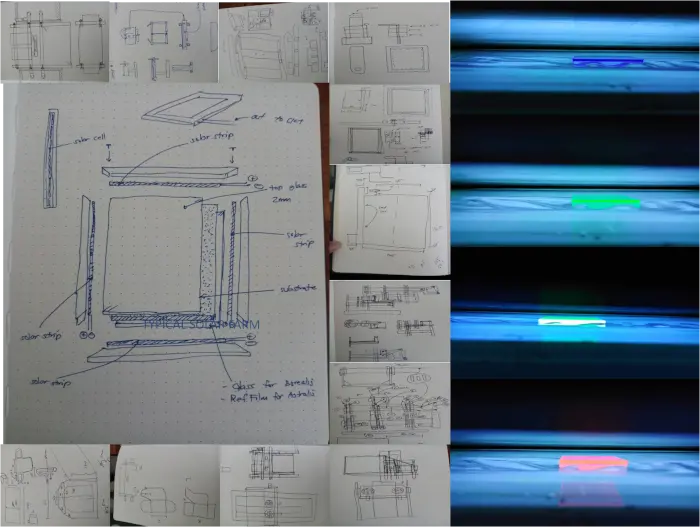
    sketches of rigs and prototypes for the AuREUS solar panels
    The James Dyson Award


    The aurora borealis was an inspiration for Maigue


    “The inspiration for the solution came from how auroras are made. High energy (gamma, UV) is degraded to a low-energy state (visible light) by luminescent particles in the atmosphere. The tech is based on this concept and used similar functioning principles.”
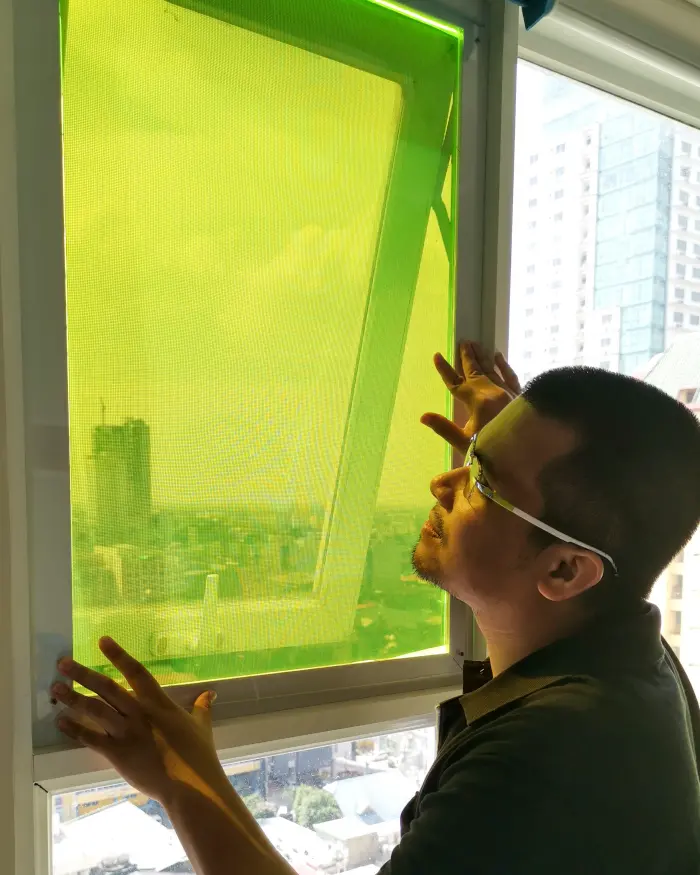
    JDA Sustainability Award 2020 AuREUS solar panels can replace glass windows
    The James Dyson Award


    “High energy particles are absorbed by luminescent particles that re-emit them as visible light. Similar type of luminescent particles (derivable from certain fruits and vegetables) were suspended in a resin substrate and are used as the core technology.”

    Montreal Convention Center with Maigue's solar panels
    The James Dyson Award


    “When hit by UV light, the particles absorb and re-emit visible light along the edges due to internal reflectance. PV cells are placed along the edges to capture the visible light emitted. The captured visible light are then converted to DC electricity. Regulating circuits will process the voltage output to allow battery charging, storage, or direct utilization of electricity.”
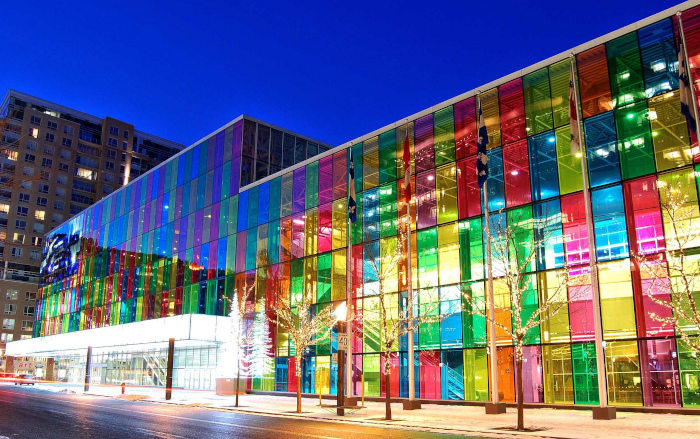
    a building covered in Maigue's solar panels
    The James Dyson Award


    The panels have the potential to change the future

    Who would have guessed that rotting produce could potentially help us create a more sustainable world? This awesome invention is certainly worth applauding. At the moment, the AuREUS is not yet ready for mass production. Maigue said that the is currently conducting further research so that his panels can be 100% efficient (it’s currently at 80%). But he’s certainly already got a big and bright vision in mind:

    “We can use AuREUS instead of typical glass windows so that the whole building can become a vertical solar energy farm. AuREUS can become a part of our clothes, our cars, buildings, and our houses. This is the change we can make for the future.”
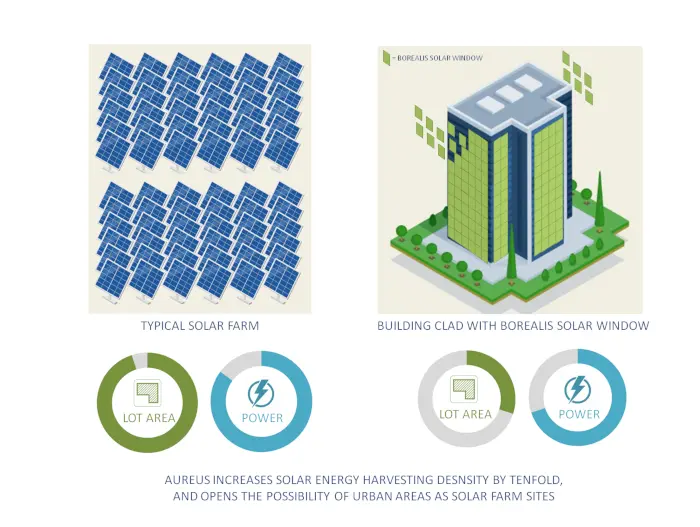
    infograph comparing conventional solar panels with the AuREUS
    The James Dyson Award

    We’re definitely willing to wait for the AuREUS to be available in the market. Once the panels are, we hope to see a more colorful and environmentally efficient world unfold before us. But for now, the conventional panels and windows will have to do.


    Watch how Maigue’s AuREUS System Technology works

    Source: The James Dyson Award | Carvey’s Interview with Dyson

    This post may contain affiliate links. Learn more.
    eco-friendly energy green inventions solar waste
    Share. Facebook Twitter Pinterest Tumblr Reddit LinkedIn
    Previous ArticleThere’s Now A Monopoly For Millennials Edition
    Next Article The Neck Hammock Supposedly Helps With Neck & Shoulder Pain

    Related Posts

    You Can Get A Dr. Jane Goodall Barbie Doll Made From Recycled Plastic

    Architects Design University Building With Accessible Green Roof

    Designer Joe Doucet Created A Wind Turbine Wall That Could Provide Enough Power For A Home

    Airstream’s ‘eStream’ Concept Camper Is Built With Modern Tech While Maintaining Retro Aesthetics

    You Can Get Solar Panel Flowers That Absorb The Sun To Heat Up Your Pool

    Adorable LED Solar Ghost String Lights

    Dairy Queen Has Released An Oreo Fudge Brownie Blizzard And It’s A Chocolate Lover’s Dream

    Food & Drink

    August has arrived! Which means that summer is on its way out. This fact may…

    Farmer Finds Rare Albino Indian Flapshell Turtle That Looks Like Melted Cheese

    Animals

    Rare turtles with an unusual yellow color have been making an appearance in multiple locations…

    Astrophotographer Bartosz Wojczynski Combines 32,000 Shots To Get A Single High-Res Image Of The Moon

    Uncategorized

    A self-taught Polish astrophotographer has captured a super high resolution image of the moon,…

    What ‘MVRDV’ Have Planned For This Abandoned Freeway In Seoul Is Amazing

    Uncategorized

    There's a disused stretch of freeway in Seoul, South Korea. It was built in the…

    © All Rights Reserved - Awesome Inventions
    • Awesome Inventions
    • Privacy Policy
    • Cookie Policy
    • FAQ
    • Advertising / Promotions
    • About Us
    • Contact Us

    Type above and press Enter to search. Press Esc to cancel.

    Manage Consent
    To provide the best experiences, we use technologies like cookies to store and/or access device information. Consenting to these technologies will allow us to process data such as browsing behavior or unique IDs on this site. Not consenting or withdrawing consent, may adversely affect certain features and functions.
    Functional Always active
    The technical storage or access is strictly necessary for the legitimate purpose of enabling the use of a specific service explicitly requested by the subscriber or user, or for the sole purpose of carrying out the transmission of a communication over an electronic communications network.
    Preferences
    The technical storage or access is necessary for the legitimate purpose of storing preferences that are not requested by the subscriber or user.
    Statistics
    The technical storage or access that is used exclusively for statistical purposes. The technical storage or access that is used exclusively for anonymous statistical purposes. Without a subpoena, voluntary compliance on the part of your Internet Service Provider, or additional records from a third party, information stored or retrieved for this purpose alone cannot usually be used to identify you.
    Marketing
    The technical storage or access is required to create user profiles to send advertising, or to track the user on a website or across several websites for similar marketing purposes.
    • Manage options
    • Manage services
    • Manage {vendor_count} vendors
    • Read more about these purposes
    View preferences
    • {title}
    • {title}
    • {title}